
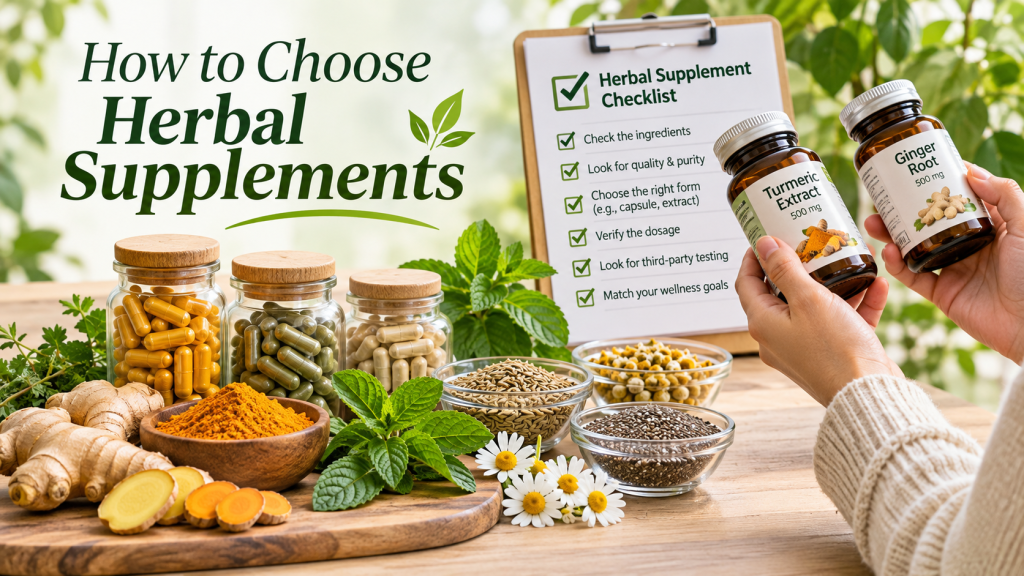
The herbal supplement aisle can turn a simple wellness goal into a confusing guessing game: identical-looking bottles promise radically different results, while important quality details hide in small print. If you want to know how to choose herbal supplements without wasting money or risking unwanted interactions, this guide shows you exactly what to check, what to question, and when to walk away.
Quick answer: What should you check before buying?
To choose an herbal supplement, define your goal, confirm that credible human evidence supports the ingredient, check medication interactions, and read the full label. Prefer products with traceable manufacturers, appropriate doses, identifiable botanicals, and independently verified quality. Ask a healthcare professional if you have a medical condition or take medicines.
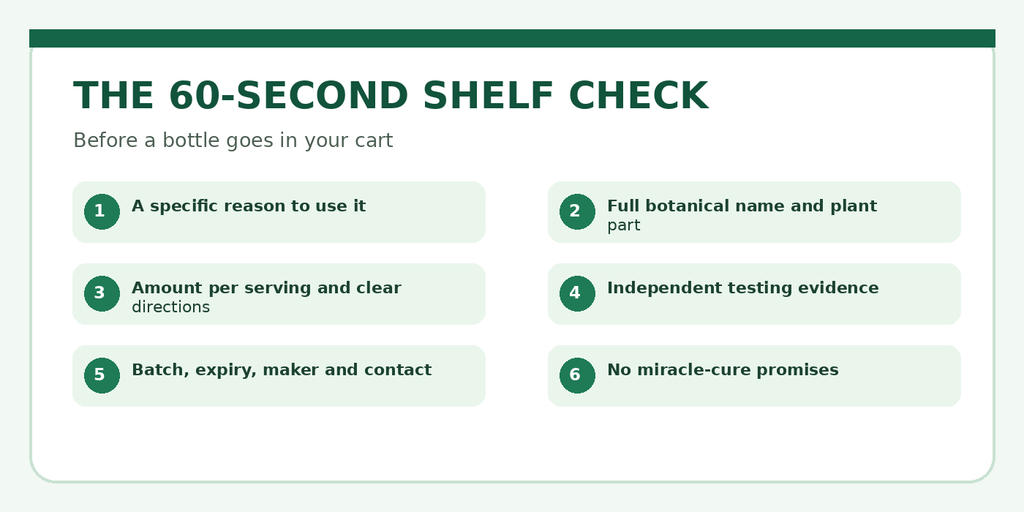
Figure: Six checks beat a catchy headline or a discount sticker.
1. Start with the health question, not the product
Your first task is not comparing brands. Write a one-sentence goal such as “I want to discuss whether a supplement could help with occasional sleep difficulty.” A clear goal keeps you from chasing broad promises like “detox,” “balance,” or “total vitality.”
Ask whether there is a diagnosed deficiency, a symptom that needs medical evaluation, or a lifestyle issue that deserves attention first. Persistent fatigue, sudden weight change, ongoing pain, unexplained bleeding, or worsening symptoms should not be treated with an unverified supplement in place of proper care.
Pro-Tip: Make a two-column note: “Outcome I care about” and “How I will measure it.” For sleep, that could mean sleep-onset time and daytime functioning rather than a vague feeling that a product is “working.”
Decide whether a supplement is necessary
A useful first principle of how to choose herbal supplements is to identify when food, sleep, or medical care may be the better first step.
A diet rich in varied foods, regular activity, adequate sleep, and management of established conditions provide more reliable foundations than a cupboard full of capsules. “Natural” describes origin, not safety or clinical benefit. Some concentrated plant extracts deliver exposures far beyond ordinary food use.
A practical purchasing rule is to require a plausible benefit, an acceptable risk profile, and a way to judge results. If one is missing, postpone the purchase and investigate rather than buying because an influencer recommends it.
2. Match the ingredient to the actual evidence
Learning how to choose herbal supplements means separating traditional use, early laboratory findings, and convincing human trials. A remedy can have centuries of cultural use and still lack reliable evidence for the exact claim on a modern package.
Look for systematic reviews and well-designed randomized human studies on the same botanical species, plant part, extract, dose, and intended outcome. A study of a concentrated standardized extract does not prove that a teaspoon of raw powder delivers the same effect.
Start with Using Dietary Supplements Wisely, which explains why study results and commercial products may differ. Research is not simply “positive” or “negative”: check participant numbers, duration, comparison group, conflicts of interest, and whether measured improvements mattered to patients.
A simple evidence ladder
Strongest practical support: Several high-quality human studies or systematic reviews show a meaningful benefit for the same formulation and purpose.
Promising but uncertain: Small trials suggest benefit, but results are inconsistent or long-term safety is unclear.
Weak: Animal, cell, chemical, anecdotal, or marketing-based claims without relevant clinical confirmation.
Not established: No credible evidence for the advertised outcome, or the product claims to cure serious disease without regulatory authorization.
💡 Quick Hack: Search the botanical’s Latin name plus “systematic review” and the outcome. It is far more informative than searching “best herb for everything,” which mostly returns sales pages.
3. Decode the ingredient label line by line
A label should enable you to identify the substance, the quantity, the serving instructions, and any additional ingredients. An attractive green bottle with no botanical details is a poor substitute for transparent documentation.
When deciding how to choose herbal supplements, insist on the species name, the plant part used, and whether the material is whole herb, dried powder, or extract. “Ashwagandha” alone tells you less than “Withania somnifera, root extract,” although the latter still requires dose and safety checks.
What an informative label should contain
Identity: Common and Latin botanical names; plant part (root, leaf, seed, bark, fruit, etc.).
Form and strength: Powder or extract, mg per serving, extract ratio when meaningful, and any standardized active-marker percentage.
Instructions: Serving size, frequency, maximum suggested use, and warnings.
Other ingredients: Fillers, capsule material, colorants, sweeteners, allergens, or other botanicals.
Traceability: Manufacturer/importer, customer contact, batch or lot number, production and expiry dates, storage guidance.
Compliance: Information appropriate for the country of sale; a foreign seal does not automatically establish local authorization.
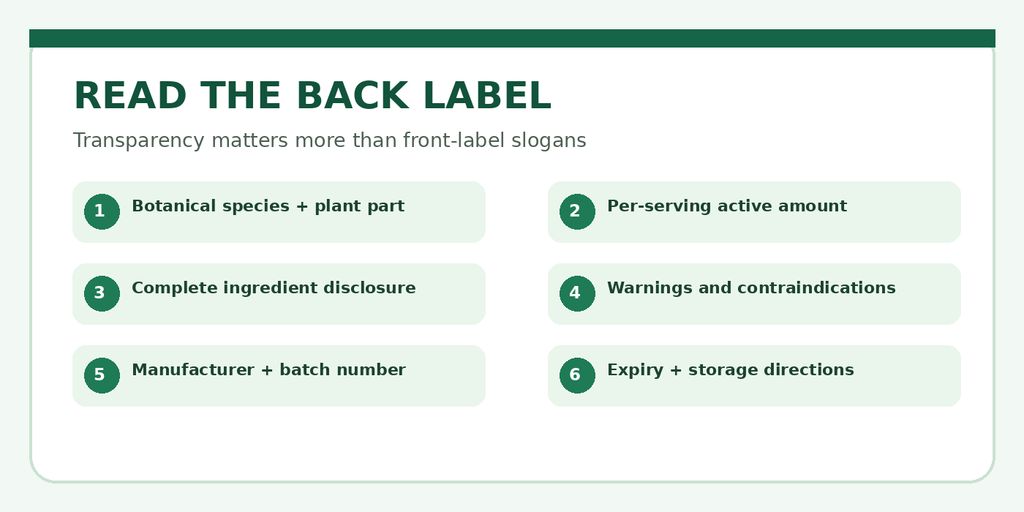
Figure: A product must identify what it contains before claims can be judged.
Whole herb, extract, or standardized extract?
Whole-herb powders contain a broader spectrum of plant compounds but may be bulky and chemically variable. Extracts concentrate selected compounds using a particular solvent or process; a “10:1” extract ratio does not itself prove tenfold clinical effectiveness. Standardized extracts control a defined constituent or marker, but standardized does not automatically mean superior, safer, or beneficial.
Two products claiming 500 mg may be incomparable if one is dried leaf and the other is an extract. Read the fine print rather than assuming equal milligrams mean equal potency.
4. Check third-party testing and manufacturer transparency
Independent testing is one of the clearest ways to reduce avoidable uncertainty about identity, contamination, and label accuracy. The NIH Office of Dietary Supplements consumer guide describes quality programs such as NSF, USP, and ConsumerLab; quality seals do not certify clinical effectiveness or guarantee safety for every person.
Check a seal against the certifier’s own database when possible, because logos can be copied or used outside their scope. Ask whether the certificate covers this exact product, manufacturing facility, or batch; those are not interchangeable.
What to request from a seller
A current certificate of analysis (COA) referencing the same lot or batch printed on the package.
Identity testing using appropriate methods for the species, plus assay results where potency is claimed.
Contamination screens relevant to the material, including heavy metals and microbiological hazards; pesticide and solvent testing where applicable.
A readable laboratory name, testing date, specification limits, and result—not only the word “passed.”
Credible quality-management details. “GMP-certified” deserves verification of the issuing organization and what was assessed.
💡 Quick Hack: Email customer support with your batch number and ask for its COA. A company that cannot explain which document corresponds to your batch is offering less transparency than a company that can.
5. Screen for drug interactions and personal risk
A herb can affect enzymes, clotting, blood pressure, sedation, glucose control, or the action of prescription medications. Some interactions are well documented; others are plausible but insufficiently studied, making individualized professional advice important.
Before selecting any product, give a pharmacist a complete list of prescribed medicines, over-the-counter drugs, vitamins, powders, teas, and occasional products. Include doses, not simply product names. Consult the FDA supplement safety overview for common risk categories.
Examples that deserve extra attention
St. John’s wort: Can reduce the effectiveness of numerous medicines through drug-metabolizing enzyme and transporter effects, including some contraceptives and other essential therapies.
Ginkgo and garlic supplements: May raise bleeding concerns, especially alongside anticoagulants or antiplatelet medicines.
Licorice root: Can affect blood pressure and potassium levels; concentrated or prolonged use may be risky.
Kava: Has been linked to serious liver injury; a “relaxation” claim is not a reassurance of safety.
Ashwagandha: May be inappropriate for some thyroid, autoimmune, liver, or medication-related circumstances; pregnancy warrants particular caution.
These examples are not a complete interaction list and do not establish that every user will experience harm. They show why self-screening by reading online testimonials is not enough.
Pro-Tip: Save photos of the front and back labels in your phone. This gives the pharmacist exact ingredients when brand names are obscure or formulas change.
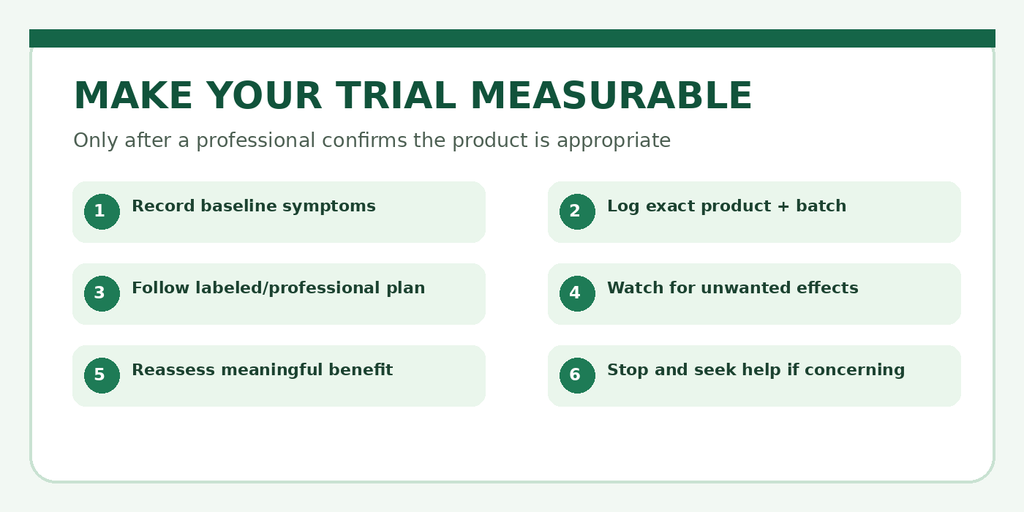
Figure: Individual circumstances can change the risk-benefit calculation.
6. Compare realistic costs instead of bottle prices
A cheap bottle can be poor value if the recommended serving requires six capsules or contains too little of the studied ingredient. Conversely, a higher price does not prove better quality, stronger effects, or superior testing.
To make how to choose herbal supplements a repeatable shopping process, calculate cost per labeled daily serving and then compare equivalent forms, strengths, testing evidence, and total duration. Do not increase a dose merely to match a study; ask a clinician whether that research applies to you.
Another key part of how to choose herbal supplements is comparing daily serving costs only after checking identity and safety.
Buyer’s toolkit: Materials, cost and skill comparison
| Tool or resource | Approx. cost | Skill needed | Why it matters |
| Phone camera + notes | Free if owned | Beginner | Photograph labels and record batch information |
| Medication list | Free | Beginner | Screen for supplement interactions with pharmacist |
| NCCIH / NIH information | Free | Beginner–intermediate | Evaluate claims and risks |
| Pharmacist/clinician review | Varies by setting | Professional help | Assess personal contraindications |
| Third-party certificate lookup | Usually free | Intermediate | Verify independent testing claims |
| Notebook or spreadsheet | Free/low | Beginner | Compare per-serving costs and outcomes |
| Optional laboratory tests | Only if clinician orders | Clinical | Investigate symptoms/deficiencies when indicated |
Costs are deliberately qualitative: clinic fees, testing, product prices, and currency vary across Pakistan and other markets. Spend on relevant professional evaluation before speculative supplements when warning signs are present.
A worked price comparison
Suppose Product A costs Rs 1,800 for 30 capsules at two capsules per daily serving: it provides 15 daily servings, or Rs 120 per day. Product B costs Rs 2,700 for 60 capsules at one capsule per day: it provides 60 servings, or Rs 45 per day. This example compares price only—it says nothing about equivalent quality or clinical effect.
💡 Quick Hack: Divide bottle price by (capsules ÷ capsules per daily serving). If the product is a liquid or powder, calculate doses from the labeled mL or grams and the supplied measuring device instead.
7. Choose the formulation you can use correctly
Capsules are portable and easy to count, but capsule shell ingredients may matter for allergies or dietary restrictions. Powders offer flexible preparation yet can be difficult to measure accurately. Liquid extracts need careful review of concentration, solvent, dropper calibration, and alcohol content where applicable.
Teas are inexpensive for certain culinary or traditional uses, but extraction varies with water temperature, steep time, and plant material. Gummies may include sweeteners and can be mistaken for candy by children; a pleasant taste does not make them harmless.
Formulation comparison table
| Form | Main advantage | Main caution |
| Capsule/tablet | Convenient labeled dose | Cannot assume all capsules have equal potency |
| Powder | Flexible use and often economical | Measuring errors; contamination risk |
| Liquid tincture | Convenient for some users | Concentration/solvent can differ |
| Tea/infusion | Familiar and inexpensive | Variable extraction and dosing |
| Gummy | Easy to take | Sweeteners and accidental ingestion risk |
Choose the lowest-complexity format that meets a legitimate need and is appropriate for the user. Never crush, split, or repackage a supplement if doing so conflicts with manufacturer directions or professional advice.
8. Buy from a traceable seller, including in Pakistan
Whether shopping from a pharmacy, online marketplace, or wellness store, choose a seller that identifies the supplier, provides a genuine invoice, and accepts questions about authenticity. For imported products, ask who imports them and whether the packaging and required documentation suit local rules.
Check for tamper-evident packaging, legible dates, batch code, correctly sealed containers, and consistency between listed and delivered ingredients. Avoid products sold through private messages with no verifiable company details, especially when the seller claims a “secret formula.”
Because registration and product-category requirements vary by jurisdiction, do not treat a US FDA webpage as proof of Pakistani legal status. Verify any claimed Pakistan approval or regulatory status with the relevant local authority or qualified professional rather than relying on marketplace badges.
9. Use a cautious, measurable follow-up plan
Even a carefully selected supplement requires ongoing attention. Confirm with a qualified professional whether a trial is appropriate, what outcomes to monitor, what adverse effects require stopping, and how long to reassess before continuing.
For the first weeks, record the date, manufacturer, batch, product details, your symptoms, any changes in medicines, and unexpected reactions. Do not add several supplements at once: doing so makes it harder to identify which product caused a change.
Figure: Tracking outcomes is better than relying on memory or marketing.
Five costly beginner mistakes—and what to do instead
Mistake: Assuming natural equals harmless. Plants contain active chemicals. Replace the assumption with a medication and condition review.
Mistake: Treating online ratings as proof. Reviews may describe service or shipping, not clinical effectiveness. Read research and confirm quality.
Mistake: Ignoring standardized-extract details. A product labeled “500 mg” may not match another formulation. Compare species, part, and extract method.
Mistake: Using herbs instead of medical treatment. Delayed care can be dangerous. New, severe, or persistent symptoms need clinical evaluation.
Mistake: Buying giant bundles to save money. Unused or expired products are wasted money. Start by establishing the need and verifying quality.
Advanced buyer tactics: quality, value, and authenticity
Once you know how to choose herbal supplements, make your decision defensible with a one-page shortlist. Score each candidate against identity, evidence, relevant dose, safety, independent testing, manufacturer disclosure, and per-serving value. A product that fails identity or safety should not win simply because it is cheaper.
Pro-Tip: Build a weighted scorecard: safety/interaction fit 30%, transparent ingredients 20%, testing 20%, human evidence 20%, and price 10%. These weights are a practical organizing tool, not a clinical scoring system; safety remains a non-negotiable gate.
Avoid the false precision of “bioavailability” marketing unless there are credible comparative human data for that exact formulation. An absorption claim is not the same as evidence of better outcomes.
💡 Quick Hack: Use a single page with two screenshots per product—ingredient panel and testing document—plus a link to the original manufacturer. It makes counterfeit-looking listings and formula differences much easier to spot.
Troubleshooting: What if something goes wrong?
The label is incomplete or the COA is missing
Do not guess what a proprietary blend contains. Contact the manufacturer for botanical species, per-serving amounts, allergen details, batch traceability, and independent testing. If the seller will not provide enough information to assess the product, select a better-documented alternative or skip it.
You develop nausea, rash, dizziness, or another new symptom
Stop taking the suspected product and seek advice from a healthcare professional promptly. Seek emergency care for trouble breathing, facial swelling, fainting, severe chest pain, or other signs of a serious reaction. Keep the packaging and batch code in case they are needed to assess the event.
You accidentally take more than directed
Do not attempt to “balance” the dose with another herb or medication. Contact a local poison-control or emergency medical service for individualized guidance, especially if a child ingested the product or symptoms develop. Bring the label, amount, and time of ingestion.
The product changes color, smell, or texture
Do not assume that a changed appearance is normal. Follow storage instructions and inspect the seal, moisture exposure, expiry, and manufacturing details. When there is doubt about contamination, discard the item according to local guidance rather than testing it yourself.
You notice no benefit
First revisit whether the target outcome was appropriate and measurable, then check that the product and duration matched the available evidence. Do not escalate doses to chase results. A pharmacist or clinician can help decide whether to discontinue the trial and investigate other explanations.
People who learn how to choose herbal supplements should also learn when to discontinue use and how to reassess ongoing need.
Long-term maintenance and safe storage
Keep supplements in their original packaging so the batch, directions, expiry, and warnings remain attached. Store according to the product instructions, away from excessive heat, moisture, and children; avoid transferring capsules into anonymous containers.
Review your complete supplement list whenever a new medicine is prescribed, a diagnosis changes, pregnancy is planned, or a procedure is scheduled. Recheck even familiar products because manufacturers can change formulas.
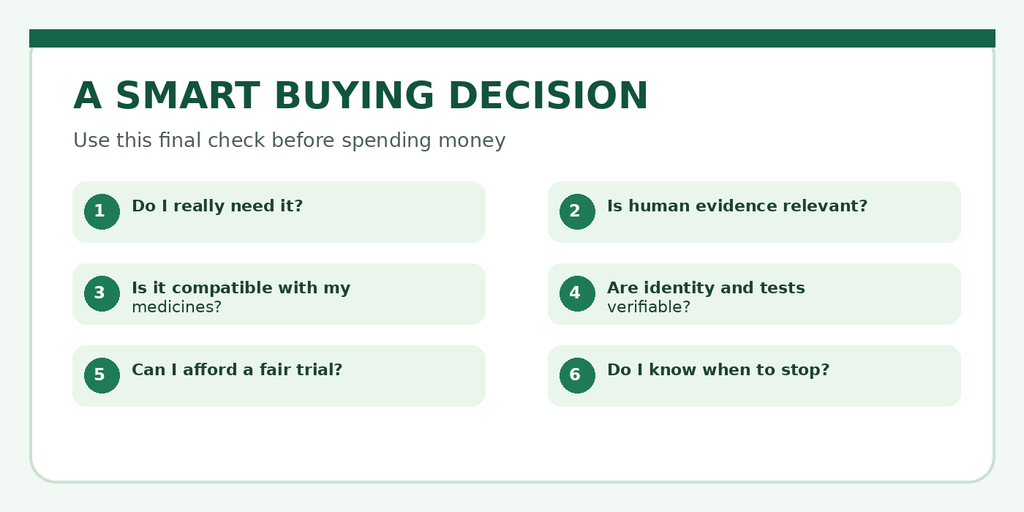
Figure: If you cannot answer a safety question, ask before buying.
Frequently asked questions
1. How can beginners tell whether a herbal supplement is trustworthy?
Begin with a transparent label, verifiable manufacturer, batch code, reasonable health claims, and meaningful independent testing. Then establish whether there is human evidence for the ingredient and whether it fits your personal health situation. A glossy bottle or influencer testimonial cannot replace those checks.
2. Are organic herbal supplements safer than non-organic products?
Organic certification may relate to cultivation standards, but it does not establish the correct dose, freedom from all contaminants, absence of medication interactions, or clinical effectiveness. Verify both relevant sourcing claims and product testing instead of equating an organic logo with medical safety.
3. Is a standardized herbal extract always better than a whole-herb powder?
No. A standardized extract indicates a controlled amount of one or more markers; it does not guarantee benefit or suitability. Compare the exact preparation used in clinical research, label transparency, risk profile, and evidence for your intended purpose.
4. Can I take several herbal supplements together?
Combinations can create overlapping side effects or interactions, including with prescription medicines. Avoid stacking products without a clinician or pharmacist reviewing the full list, and remember that multi-ingredient blends can make adverse reactions harder to investigate.
5. What is the best time to take herbal supplements?
There is no universal schedule. Timing depends on the botanical, product formulation, food requirements, other medicines, and individual circumstances. Follow the label only after confirming that the supplement is appropriate for you; ask a pharmacist about spacing from medicines when needed.
6. Should I choose the cheapest supplement available online?
Price is useful only after products pass basic safety and quality checks. Compare cost per serving across similar formulations and favor a traceable seller with verifiable identity and testing. A very low price coupled with anonymous sourcing or exaggerated claims is a reason to investigate, not an automatic bargain.
Final buying checklist and conclusion
The safest answer to how to choose herbal supplements is not a brand name—it is a process. Define a realistic need, investigate the evidence, read every ingredient, review interactions, verify testing, calculate value, and monitor whether use remains justified. When a critical answer is missing, a purchase can wait.
Explore more practical wellness information at Herbal Healthcare. What is the one detail you find hardest to verify when comparing herbal supplement labels—ingredient strength, independent testing, or drug interactions? Share your question in the comments.